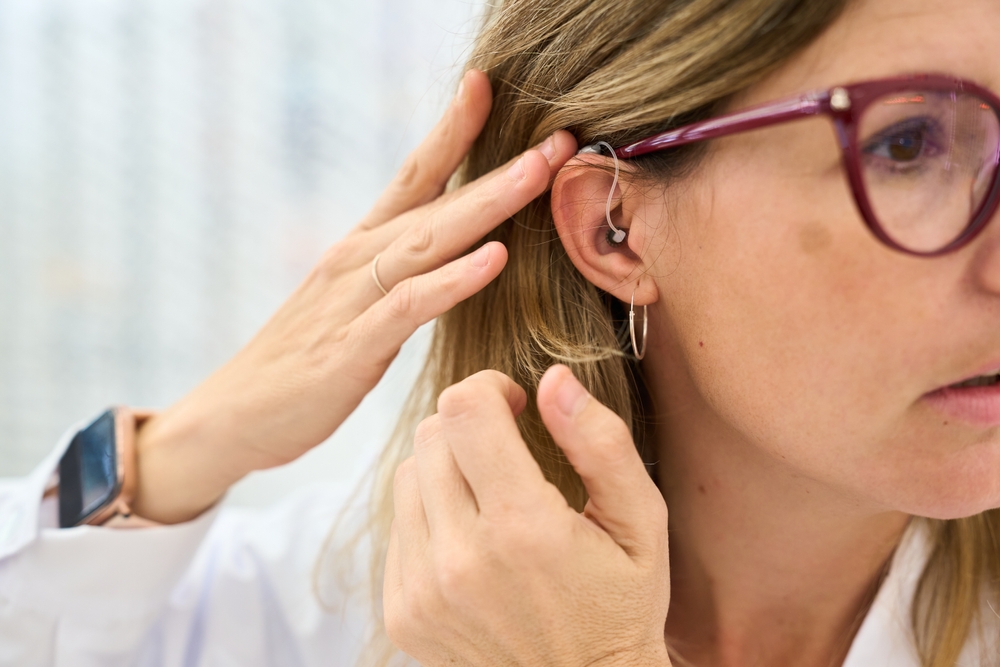
Many people delay getting hearing aids because they don’t think they’ll like how they look or feel. Such reluctance is perfectly natural when you consider past technology! In some cases, people even worried that they might be left out of conversation altogether by others who assumed they wouldn’t be able to hear or comprehend.
This obsolete perception remains deeply embedded in the public consciousness, creating a massive barrier to proactive treatment. In reality, the sophisticated hearing instruments of the present era deliver a look and feel that shatters these old assumptions. Ongoing innovations in cosmetic engineering mean today’s options are ultra-small, seamlessly comfortable, and beautifully hidden from public view.
If cosmetic anxiety has caused you to delay treating your hearing loss, it is highly recommended that you evaluate the sophisticated options now available.
The Outdated Devices of Your Imagination Have Been Replaced
When asked to visualize a hearing instrument, the average person still envisions an awkward, highly conspicuous piece of hardware visible from yards away. If that is the visual you hold, you are fundamentally remembering outdated medical equipment from decades past.
Since that era, the manufacturing landscape for hearing solutions has completely transformed. Continuous refinements in ergonomic styling, nanometer-scale circuitry, and digital audio engineering have radically overhauled the modern cosmetic profile. The resulting devices are beautifully downsized, highly aerodynamic, and built to match lifestyle needs by remaining completely hidden.
Numerous modern instruments are inserted completely within the ear canal structure, rendering them undetectable throughout standard daily dialogue. Others rest behind the ear but are so compact and lightweight that they’re easy to overlook, especially when matched to your hair or skin tone.
A Taxonomy of Modern Styles: From Totally Hidden to Ultra-Streamlined
If you are curious about the structural choices available for your rehabilitation, here is an accessible overview of current styles:
The Invisible-in-Canal (IIC) Form Factor
These are as discreet as it gets. The IIC style fits exclusively within the deep internal canal and is built using a custom impression of the patient’s ear passagographic anatomy. Spoken interactions at arm’s length occur without anyone realizing a medical device is present. They’re a popular choice for people with mild to moderate hearing loss who prioritize subtlety.
Modern Standards: Receiver-in-Canal (RIC) / Receiver-in-the-Ear (RITE)
Statistically, this open-fit design represents the dominant choice among current consumers. A tiny component sits behind the ear, connected by a nearly invisible wire to a small speaker in the ear canal. To a casual observer, their clean lines often mimic high-end commercial wireless earbuds. Surrounding individuals will remain completely unaware of the technology unless they actively look for it.
Streamlined Behind-the-Ear (BTE) Systems
These sit fully behind the ear and are slightly larger, but they’re still far more streamlined than older versions. Clinically indicated for profound or severe hearing deficits, they deliver immense acoustic power without the outdated, conspicuous mass of the past.
The bottom line is simple: modern assistive hearing systems are crafted to serve your life quietly, not to draw attention to your ears.
The Functional Revolution: Modern Instruments Are Tiny Supercomputers
It is vital to recognize that this technological revolution is not simply a visual upgrade. Contemporary devices are essentially miniature smart hubs rather than historical medical hardware. Most current systems boast universal wireless syncing, channeling smartphone calls, high-definition music, and television broadcasts directly to your internal receivers.
Equipped with dedicated smartphone applications, they allow users to manipulate volume matrices or toggle environmental programs without making manual physical adjustments. Should you transition into a loud social environment, you can instantly recalibrate your directional microphones via your phone screen. Advanced rechargeable battery banks have effectively replaced the small, fragile power cells that used to cause immense frustration. The process is as simple as placing the units into their charging dock each night, identical to charging your cell phone.
Empowerment Over Hesitation: Redefining Hearing Health Care
Despite understanding these technological quantum leaps, psychological resistance remains highly common. Acknowledging a sensory deficit and investigating rehabilitation options often forces a difficult confrontation with our own vulnerability and bodily changes. This mental hurdle can make an individual feel exposed, creating a false impression of losing authority over personal wellness.
But here’s a different way to look at it: Hearing aids aren’t a sign that something has gone wrong. They are merely an intelligent adaptation to a universal milestone of aging that impacts us all eventually. Choosing to hear better is absolute evidence that you are choosing to optimize your body and enhance your overall quality of life.
Visualize the freedom of utilizing a completely covert acoustic system that restores your ability to track jokes, engage in crowded restaurants, and capture every nuance of the activities you love. That level of sensory restoration is incredibly liberating!
Discover the Reality of Modern Otolaryngological Solutions
The most effective method to permanently banish an obsolete stereotype is to personally examine current clinical options. We invite you to come in, ask questions, and explore your options with no pressure and no commitment necessary. Treat this as a risk-free exploratory step to comprehend the incredible aesthetic shift that has occurred in our field.
You will likely be utterly delighted to discover how microscopic, physically seamless, and high-performing today’s options truly are! Do not let outdated myths delay your wellness—call our specialized practice or book your appointment online today.
